


The Titan and the Texan: A Correspondence of Words
- Jan 3
- 3 min read
My newest story, a novelette that will be online soon, focuses on the relationship of two amazing men during the early twentieth century: Lovecraft and Howard! #Lovecraft #RobertEHoward #Fantasy #WeirdStories
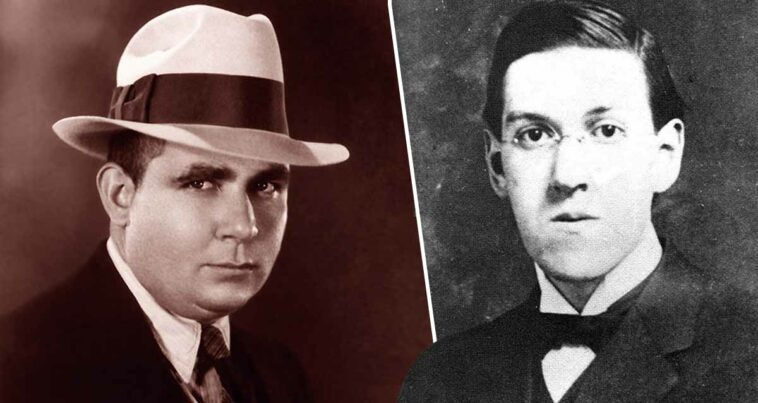
In the golden age of the pulp magazines, two of the most influential minds in speculative fiction built a bridge across the American landscape, spanning the distance between the ancient, cobblestoned streets of Providence and the rugged, dusty plains of Cross Plains, Texas. H.P. Lovecraft and Robert E. Howard never shared a room, but they shared a vision of the "weird" that would reshape literature forever. Their relationship began in 1930 with a simple fan letter and blossomed into a monumental correspondence that totaled hundreds of thousands of words.

They were an unlikely pair on the surface. Lovecraft was the quintessential New Englander, an intellectual who valued the traditions of the 18th century and the cold, clinical truths of science. Howard was "Two-Gun Bob," a man of immense physical vitality who found his muse in the blood-soaked history of the frontier and the primal law of the sword. Yet, beneath these differing veneers, they found a kindred spirit. They engaged in a legendary, years-long debate over the merits of civilization versus barbarism, a literary sparring match that forced both men to sharpen their philosophies and, ultimately, their prose.
The intellectual bond between these two men acted as a catalyst for the entire "Lovecraft Circle," a loosely knit group of writers who traded ideas like currency. While Lovecraft provided the cosmic framework—the idea that humanity is an insignificant speck in a cold, uncaring universe—Howard provided the human response to that terror: the defiant, blood-pumping struggle for survival. Their letters were more than just shop talk; they were a laboratory where the modern concepts of horror and fantasy were synthesized. Howard’s influence actually pushed Lovecraft to ground his stories in more historical and anthropological detail, while Lovecraft encouraged Howard to look beyond the physical and embrace the truly alien.

The news of Howard’s suicide in June 1936 arrived as a devastating blow to Lovecraft. Howard’s father sent a brief, heartbreaking note to Providence, and the impact on the "Old Gentleman" was immediate and profound. Lovecraft was fundamentally shaken, finding it nearly impossible to reconcile the vibrant, muscular energy of Howard’s writing with the tragic finality of his death at just thirty years old. He felt the loss not just as a colleague, but as a brother.
Lovecraft spent a significant amount of his dwindling energy writing to other members of their circle, such as E. Hoffmann Price and Clark Ashton Smith, to process the tragedy. He was haunted by the "terrible waste" of a genius cut short in its prime. Lovecraft noted that Howard had a "richness of personality" that the world had only begun to see. He took it upon himself to ensure Howard’s unpublished manuscripts were preserved, acting as an informal literary executor to make sure the "Two-Gun" legacy didn't vanish into the Texas dust.

This period of mourning was also a period of physical decline for Lovecraft. The man who had once written thousands of letters a year found his hand growing heavy. The loss of Howard seemed to confirm Lovecraft’s own pessimistic worldview—that the brightest lights are often the first to be extinguished by a world that doesn't understand them. He often reflected on the "barbarism" Howard had championed, perhaps finding a grim validation in the way Howard chose to leave the world on his own terms rather than succumb to the "civilized" decay Lovecraft himself was currently enduring.
The shared legacy they left behind is why we still see their names linked today on library shelves and collections. They proved that a friendship built entirely on ink and paper could be as strong as any forged in person. Lovecraft’s final letters regarding Howard aren't just tributes to a writer; they are the eulogies of a man who realized that with Howard’s passing, a specific kind of magic had left the world, leaving the "Old Gentleman" of Providence to face the encroaching shadows alone.


Comments